A Laptop VLM Solves 44% of Naver's Receipt CAPTCHAs
If you log in to Naver often enough, you’ll eventually see a receipt instead of a login form. It’s photographed at an angle, torn into strips, and covered in scribbled letters, and underneath is a question:
What is the unit price of the least bought item per unit?
This is Naver’s receipt CAPTCHA. The idea is clever: instead of asking you to decode wavy letters, it asks you to read a messy document and reason about it. The catch is that reading messy documents and reasoning about them is exactly what vision–language models (VLMs) are trained to do.
So I measured it. The short version:
- An unmodified, open-weight 7B model on a 16 GB laptop answers 43.8% of real challenges correctly.
- The 7B model gets ~62% of the “just read it off the receipt” questions right, despite the tears and scribbles.
- It fails mainly on multi-step arithmetic, such as totals and “unit price of the least bought item”.
- If failed attempts can be retried on fresh challenges, 43.8% per attempt means a ~94% chance of passing within five tries.
A longer write-up with confidence intervals and significance tests is coming as a preprint. This post is the readable version.
What the challenge looks like
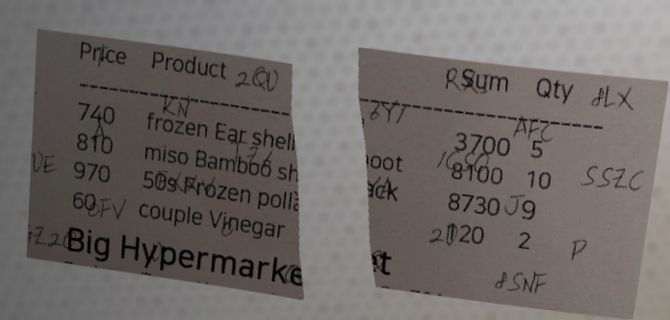
A real challenge from April 2026. Question: “How many kinds of items did the customer purchase?”
Every challenge is a 670×320 image plus one English question. The defenses are all about layout, not lettering:
- the receipt is torn into two or three strips, rotated and bent in perspective;
- handwritten letter/digit strings are scattered on top, sometimes right over the prices;
- parts of the receipt are cut off or hidden in the tear;
- the column order (Price / Qty / Sum / Name) changes from receipt to receipt.
The printed text itself is a clean, ordinary font. A model that can locate the right row can read it.
The questions are surprisingly repetitive
I collected 1,100 challenges on 9 April 2026. Across all of them there were only 295 distinct question strings, and nine fixed templates account for most of them:
| Question type | Share of challenges |
|---|---|
| Counting / quantity (“How many items cost 370 won per unit?”) | 43.8% |
| Unit price of the most expensive / most bought item | 14.2% |
| Unit price of a named item (“…of frozen Skate?”) | 10.2% |
| Unit price of the cheapest item | 7.5% |
| Unit price of the least bought item | 7.4% |
| Receipt total | 5.8% |
| Address fill-in-the-blank | 4.9% |
| A digit of the store’s phone number | 3.9% |
| Rare types | 2.0% |
These split into two kinds:
- Lookup questions, where the answer is printed on the receipt (a named item’s price, the address, a phone digit).
- Aggregate questions, where the answer has to be computed by counting, comparing, summing, or dividing a line total by its quantity.
That distinction turns out to explain almost everything.
The experiment
I hand-labeled 128 of the collected challenges and asked three open-weight models from the Qwen VL family to answer them zero-shot: no examples, no fine-tuning, no step-by-step prompting. The prompt was just the image, the question, and “return only the answer”. Everything ran locally on an M1 Pro laptop with 16 GB of memory.
| Model | Correct | Accuracy (95% CI) |
|---|---|---|
| Qwen2-VL-2B | 20 / 128 | 15.6% (10.3–22.9) |
| Qwen2.5-VL-3B | 34 / 128 | 26.6% (19.7–34.8) |
| Qwen2.5-VL-7B | 56 / 128 | 43.8% (35.5–52.4) |
Both jumps (2B→3B and 3B→7B) are statistically significant on paired tests (p = 0.024 and p < 0.001). My labeled set slightly over-represents the easy named-item price questions. Reweighting to the real question mix brings the 7B model to about 37%, still roughly three in eight.
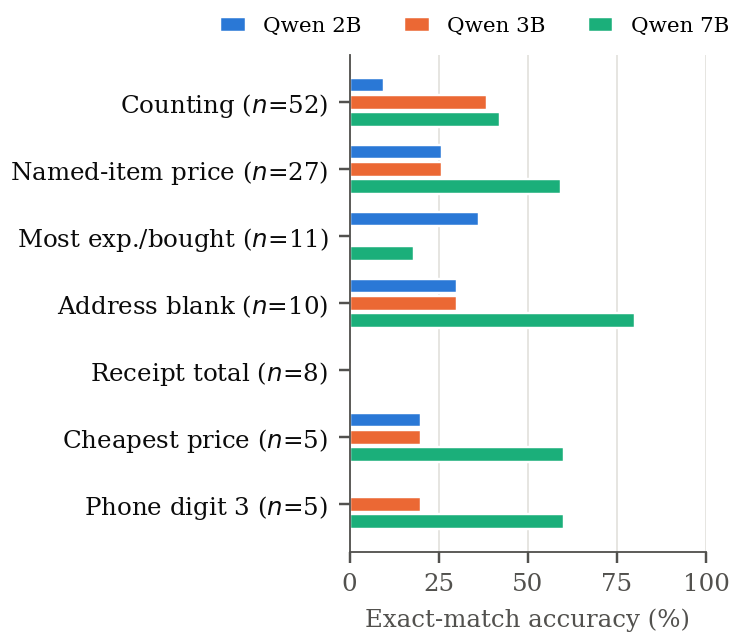
Where the 7B model succeeds, and where it doesn’t
| 7B accuracy | |
|---|---|
| Lookup questions (47 items) | 61.7% |
| Aggregate questions (81 items) | 33.3% |
The torn strips and scribbles didn’t stop it from reading: it got 8 of 10 address blanks and 16 of 27 named-item prices. What it can’t do yet is the arithmetic:
- Receipt totals: 0 of 8. It answers with a plausible amount of the right size (7,000 for 6,800; 12,000 for 10,300) but never the exact total.
- “Least bought item” unit price: 0 of 4. It often returns a price from the wrong row, or a line sum instead of a unit price.
- Counting shortcuts. For “How many items cost N won per unit?” it often just says
1, and for “total number of products” it often says10or100. It isn’t really attempting the count.
In other words, the model reads the receipt fine and skips the procedure. That gap is the one that step-by-step prompting, tool use, and task-specific fine-tuning are known to close.
I also screened five other open models on a small 17-item pilot. MiniCPM-V was about as good as Qwen-7B, while LLaVA-7B and BakLLaVA barely registered. Llama 3.2-Vision 11B scored 15% over 60 items, mostly because it kept answering in full sentences. Parameter count alone doesn’t predict success here.
What 44% means in practice
A CAPTCHA doesn’t have to be unbeatable; it has to make automation expensive. If each failure brings a fresh, independent challenge, per-attempt accuracy compounds quickly:
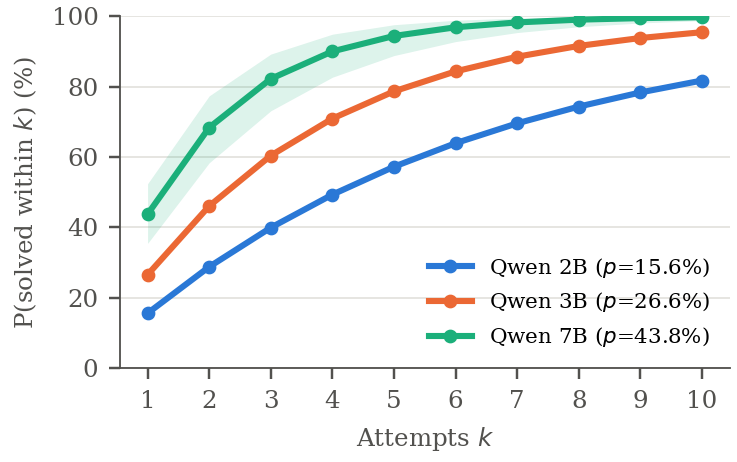
| Attempts | Chance the 7B model has passed |
|---|---|
| 1 | 43.8% |
| 3 | 82.2% |
| 5 | 94.4% |
| 10 | 99.7% |
Three things stand out:
- The visual defenses don’t block reading. The torn, scribbled receipt stopped the 7B model on only about 40% of lookup questions.
- The remaining margin is arithmetic, which is the capability current models are improving fastest at.
- It all runs on the attacker’s own laptop. There’s no per-query cost and no third-party solving service, so API pricing and similar controls don’t apply.
Important caveats. This is a per-challenge accuracy, not an end-to-end bypass rate. I didn’t test Naver’s rate limits, lockouts, or risk scoring, and I never submitted an answer to the live site. Any of those could cut the number of retries an attacker actually gets. I also didn’t measure how well people do. Anecdotally, the least-bought-unit-price questions are a chore for humans too, and that deserves a proper user study.
Correcting the record on fine-tuning
An earlier draft of this project claimed that a LoRA adapter on the 2B model “didn’t help”. When I audited the saved files, that experiment turned out to be broken rather than negative:
- the adapter’s trained weights (its
Bmatrices) were exactly zero, meaning it never learned anything; - its “results” matched the untrained model’s answers on all 120 items;
- the evaluation step in the pipeline was a placeholder;
- and it trained on the same items it was tested on.
So that claim is withdrawn.
A corrected run is in progress now: Qwen2.5-VL-7B (4-bit, MLX) with a LoRA adapter, evaluated by 4-fold cross-validation. Each adapter trains on 96 labeled challenges and is scored only on the 32 it never saw. The same 4-bit model with the same prompt scores 59 / 128 (46.1%) zero-shot, which is the baseline to beat.
The fine-tuning run is still going. I’ll update this post with the held-out results, gain or no gain, when it finishes.
What Naver could do
- Don’t rely on this challenge alone. Pair it with server-side risk signals and per-account / per-IP attempt limits, so the retry math above stops working.
- Re-test regularly against current open models. A defense that holds against last year’s models won’t necessarily hold against next year’s.
- Make questions easy for people and hard for models, not just harder. Harder arithmetic mostly burdens legitimate users. Any change should be validated with a human study.
Limitations
- Small sample. 128 labeled items give roughly ±8-point intervals overall, and most per-type numbers rest on a handful of items.
- Confounded 7B comparison. The 7B zero-shot run used a different runtime, quantization and prompt from the 2B/3B runs. The 4-bit MLX rerun (59/128) lands in the same place, which is reassuring.
- Labels. One annotator, with no confirmation from Naver’s server. A spot-check of 18 labels found 2 errors, and neither changes any score.
- Single snapshot. All data come from one day in April 2026, and the challenge may have changed since.
Ethics
I collected challenge images only, never submitted answers, never touched anyone else’s account, and I’m not releasing a ready-to-use solver or trained adapter.